
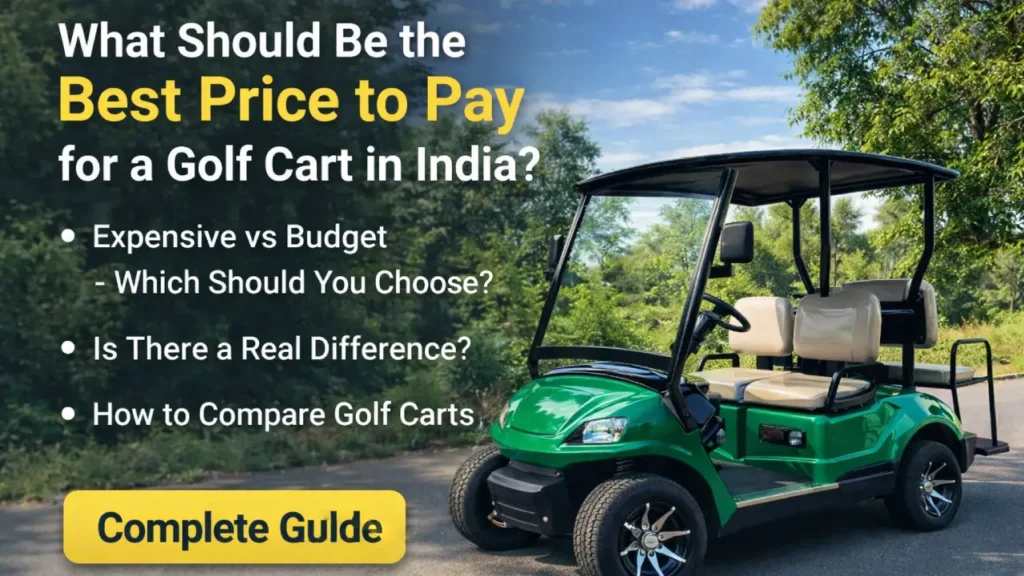
Golf carts are no longer just for golf courses. Today you’ll find them gliding through gated societies in Gurugram, ferrying guests at Goa resorts, and zipping across hospital campuses in Bengaluru. The problem? Most people who want to buy one have no idea what they’re actually paying for and whether that extra ₹1.5 lakh is worth it or just a fancier sticker.
What is the Right Price to Pay for a Golf Cart in India?
There is no single correct answer, but here’s a framework that actually makes sense.
Prices in India range from 3 Lakh for basic entry-level models to ₹6,00,000 for premium 12-seater carts from established manufacturers. Most commercial-grade 4–6 seater electric golf carts fall in the ₹3,50,000–₹4,50,000 range.
Price Range Breakdown by Use Case
Budget (₹3L – ₹4L): These are mostly 2-seaters, suited for very flat terrain and very low daily use — think a small farmhouse or a compact housing complex where the cart does maybe 2–3 km a day. Don’t expect long battery life or great build quality here.
Mid-range (₹3.5L – ₹4.5L): This is the sweet spot for most buyers. A 4-seater starts from around ₹3,90,000 and a 6-seater from ₹4,50,000. These are suitable for housing societies, small resorts, offices, and event venues. You get decent motor power, reasonable range, and some warranty support.
Premium (₹4.5L – ₹6L+): An 8-seater is priced from ₹4,80,000 upwards. These are built for heavy daily use, hilly terrain, and commercial operations. You get better suspension, lithium-ion batteries, stronger motors, and proper after-sales service.
New vs. Used Golf Cart Prices in India
A used golf cart can seem like a great deal until it needs new batteries, which can cost almost as much as the cart itself.
A well-maintained golf cart can last between 10 to 15 years depending on maintenance, terrain, and storage conditions.
If you’re buying used, always check the battery age first. A 3-year-old cart with original lead-acid batteries is almost certainly going to need a replacement soon, which means you’re about to spend another ₹40,000–₹80,000. That changes the math completely.
Should You Buy an Expensive Golf Cart or a Cheap One?
The honest answer: it depends entirely on how you’ll use it.
When a Cheap Golf Cart Makes Sense
A budget cart works fine if:
- Your property is flat and smooth
- The cart will be used for short distances (under 10 km a day)
- You’re testing the waters before committing to a bigger purchase
- You’re using it for a one-time event or short-term need
When Investing in an Expensive Golf Cart Pays Off
Go for a mid-range or premium cart if:
- The cart will run daily, carrying multiple passengers
- Your terrain has slopes, bumps, or uneven paths
- You’re buying it for a commercial property (resort, hospital, golf course)
- You want to avoid constant repair bills
Models with enhanced suspension command a 7–12% price premium but offer better longevity on uneven paths. That’s not a marketing claim, it’s the difference between a cart that lasts 8 years and one that starts creaking in 18 months.
The real cost of a cheap cart isn’t the sticker price. It’s the battery replacements, the motor repairs, and the downtime when it stops working in front of your resort guests.
Top Golf Cart Brands Available in India
Before you think about cheap vs. expensive, you need to know what’s actually available in India and what to look for in a manufacturer.
Established Indian manufacturers — Several reputable Indian brands build carts specifically engineered for local conditions — including road quality, weather, and power supply variations. These offer good value, accessible service centres, and spare parts that are actually available in India.
International brands with Indian distributors — Some global brands operate through exclusive Indian distributors and service major metro cities. These tend to be premium-priced but come with stronger build quality, wider dealer networks, and longer warranty terms.
No-name imports (avoid these) — Cheap Chinese imports are widely available online. Avoid these for anything beyond the most casual use. Spare parts are nearly impossible to find, and there is no service support when something goes wrong.
When evaluating any brand, ask specifically: Do they have a service centre within your city? Can they provide references from existing customers in India? What does the warranty actually cover?
Is There a Real Difference Between Expensive and Cheap Golf Carts — or Is It Just Branding?
This is the question most people are secretly asking. And the answer is: there is a very real difference — it’s just not always visible on the surface.
What You Actually Get at Each Price Point
The comparison table above shows the breakdown, but here are the things that actually matter in real use:
Motor quality — AC motors are better than DC motors for torque and long-term reliability. Cheap carts almost always use DC motors. Premium carts use AC. You notice this the moment you go uphill or carry 4 passengers.
Frame material — Cheap carts use basic steel. High-strength steel that is resistant to corrosion is the right choice for Indian conditions. Premium carts go a step further with aluminium frames that don’t rust at all.
Battery type — This is the biggest quality difference. Cheap carts come with lead-acid batteries. Better carts come with lithium-ion. Lithium-ion adds 25–30% to the cost over lead-acid, but it’s worth it — more on this in the next section.
Range — Most quality electric golf carts in India offer a range of 60–80 km per charge. Cheaper models with weaker batteries often give you 30–40 km before they slow down noticeably.
Where Cheap Carts Cut Corners (And Where It Matters)
The parts that fail silently are always the ones you can’t see easily:
Wiring and controllers — Cheap carts cut costs here. Bad wiring in Indian heat and monsoon conditions is a real problem. You may not notice it until the cart simply stops.
Suspension — No independent suspension means every pothole in your driveway is felt directly. Over time, this also strains the frame and joints.
Braking — Premium carts come with hydraulic brakes. Budget carts use mechanical drum brakes that wear faster and perform poorly in the rain.
Certifications — For road legality in India, verify ARAI certification and ISO 9001 manufacturing standards. Many cheap carts have neither.
How to Differentiate Between an Expensive and a Cheap Golf Cart
When you’re standing in front of two carts and one is ₹1.5L cheaper, here’s how to actually tell them apart.
5 Physical Checks Before You Buy
- Press on the frame joints — Cheap carts wobble. Quality frames feel solid and don’t flex when you push on the corners.
- Check the seat foam — Sit down hard. Budget carts use thin foam that compresses immediately. Good seats bounce back.
- Spin the wheels by hand — They should spin smoothly and quietly. Rough wheel bearings mean higher maintenance costs ahead.
- Look under the cart at the wiring — Is it properly covered and routed? Or is it a mess of exposed cables? Exposed wiring in Indian weather is trouble.
- Test the brakes at low speed — They should engage smoothly and evenly. Any pull to one side or sponginess is a warning sign.
Key Specs to Compare Side by Side
Ask the dealer for these numbers in writing before signing anything:
- Motor type and wattage — Look for 3 kW minimum for 4-seaters. Commercial carts typically range from 1–5 kW.
- Battery type and Ah rating — Lead-acid or lithium-ion? Higher Ah = longer range.
- Max payload — Can it actually carry the weight you need?
- Warranty — Reputable manufacturers typically offer 2–3 years on the vehicle frame and 1–2 years on electrical components. Lithium-ion batteries usually carry 3-year warranties covering 70%+ capacity retention.
- IP rating — For Indian monsoons, look for at least IP54 on electrical components.
What If You Buy a Good Battery but a Cheap Golf Cart?
This is actually a very smart question. A lot of buyers try this approach — buy the cheapest cart and upgrade the battery. Here’s the reality.
Can a Premium Battery Compensate for a Budget Cart?
Partially yes — and it’s worth considering.
The battery is responsible for range, consistency of power, and charging convenience. Lithium batteries can cycle up to 10 times longer than lead-acid batteries. While lead-acid batteries last around 300 to 500 charge cycles, lithium batteries can endure upwards of 2,000 charge cycles.
So if your cart came with a lead-acid battery and you swap it for a lithium unit, you’ll notice:
- The cart feels faster and more responsive (lithium maintains consistent voltage throughout the charge)
- You won’t need to refill water or clean acid buildup every month
- A lithium-ion battery can reach 80% charge in about an hour, and full charge in under 3 hours — versus roughly 8 hours for a lead-acid battery.
That said — the battery upgrade won’t fix a bad motor, weak suspension, or poor frame. If your cart struggles on slopes, it’ll still struggle. If the wiring is bad, it’s still bad.
Best Battery Upgrade Options Available in India
Lead-acid (tubular plate) — Still the most affordable option in India. Tubular plate design lasts longer than standard flat-plate batteries. Suitable if budget is the priority and you don’t mind occasional maintenance.
Lithium-ion (LiFePO4) — This is the gold standard. Lithium batteries last 5–10 years versus 2–3 years for lead-acid, and weigh roughly one-third as much — which directly improves the cart’s handling and efficiency.
Before you upgrade, check compatibility. If the lithium battery’s voltage and amp-hour capacity match the existing lead-acid battery, it can often be plugged in directly. If not, the cart may need modifications or a retrofit kit. Always confirm with your supplier before purchasing.
In India, lithium battery packs for golf carts are available through IndiaMart and reputable Indian EV manufacturers. Expect to pay ₹40,000–₹1,20,000 depending on capacity and brand.
Conclusion: So What Should You Actually Do?
Here’s the short version of everything above:
If you run a resort, housing society, or any commercial property → Don’t go below ₹3.5L–₹4.5L. Get a 4 or 6-seater with an AC motor, lithium-ion battery, and at least a 2-year warranty.
If your terrain has slopes or rough surfaces → Pay the extra for independent suspension. That 7–12% premium pays off in the form of better longevity and a smoother ride on uneven paths.
If you’re on a tight budget → Buy a decent mid-range cart with a lead-acid battery first. Then upgrade to lithium when the battery needs replacement — you’ll get most of the benefits at a lower initial cost.
The bottom line: the “best price” isn’t the lowest price. It’s the price where the cart’s quality matches your actual use. Spend a little less than you need, and you’ll spend more fixing it.
Buy Smart. Pay Right. Drive Better.
Want us to help you choose the ideal golf cart with the best value and long-term reliability.